The Right to Protest Under Attack in the United Kingdom
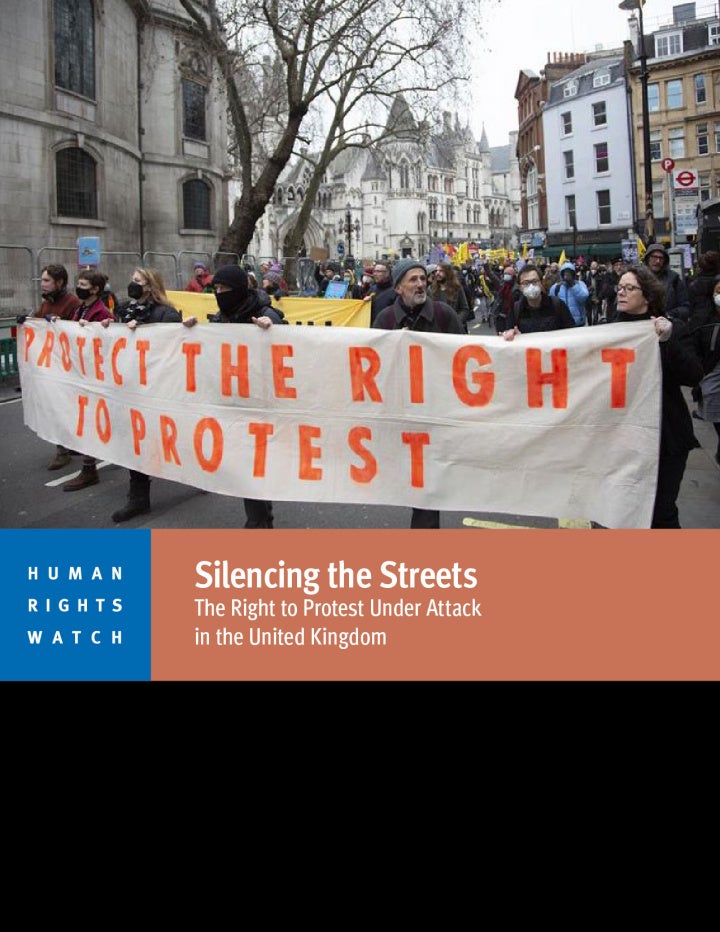
Demonstrators hold a banner during a protest against the Police, Crime, Sentencing and Courts (PCSC) bill on January 15, 2022 in London, UK.
© 2022 Rasid Necati Aslim/Anadolu Agency via Getty Images
Recent legislative measures and resulting actions by the authorities in the United Kingdom (UK) have significantly constrained the right to protest. These legal restrictions and actions undermine the right to freedom of expression and peaceful assembly. By granting broad discretionary powers to police and criminalizing peaceful protest tactics, the UK state risks silencing dissenting voices, discouraging civic participation, eroding democratic accountability, and ultimately fraying the fabric of democracy itself.
While the UK government’s obligation to ensure the right to peaceful assembly and freedom of expression is enshrined in both domestic and international legal frameworks—including the Human Rights Act 1998, the International Covenant on Civil and Political Rights (article 19 and 21) and the European Convention on Human Rights (articles 10 and 11)—legal developments have markedly expanded state powers to regulate and criminalize protest activity. These legislative changes, most notably through the Police, Crime, Sentencing and Courts Act 2022 (hereafter PCSCA 2022) and the Public Order Act 2023 (hereafter POA 2023), reflect a growing governmental emphasis on maintaining public order and safeguarding key infrastructure at the expense of civil liberties.
The current government's ongoing failure to reverse abusive restrictions on protest introduced by its predecessor is compounded by its introduction of the Crime and Policing Bill 2025, before Parliament at time of writing, which proposes further restrictions on protest rights, and its decision to proscribe a pro-Palestine direct action group as a terrorist organization, a move criticized by United Nations (UN) human rights experts as endangering civil liberties by conflating protest with terrorism.
The shift in legal orientation and practice in relation to protest has been driven in part by successive UK governments’ responses to disruptive protest tactics employed by environmental and social justice movements, such as Extinction Rebellion and Just Stop Oil. In doing so, the state has introduced vague and expansive legal thresholds, such as "serious disruption to the life of the community," which grant police broad discretion to intervene in and criminalize protest activities. These changes undermine democratic accountability and suppress dissent as they are open to broad interpretation, giving police and authorities wide latitude to decide what constitutes illegal protest, while also having a deterrent effect on protesters.
This report assesses the impact of the changes to protest legislation and examines their effects on the right to protest and how expanded police powers, criminalization of protest activities, and the jailing of protestors for acts that previously resulted in fines risks having a chilling effect on freedom of assembly.
Human Rights Watch’s research during 2024 and 2025 indicates that the new anti-protest legislation has resulted in arbitrary bans and undue restrictions on protests, arbitrary arrests, criminal charges for peaceful protest activities and an increasing number of custodial sentences.
Human Rights Watch interviewed people organizing and participating in peaceful protests. Protesters described a consistent pattern of confusion on the part of protesters and police, conflicting police instructions, and arbitrary arrests, even in cases where prior coordination with police had taken place. Protesters were detained for hours, had equipment seized, and in some cases were charged with public order offenses with little or no justification provided. Examples include the arrests of Republic activists during King Charles' coronation and the charges brought against activists for Palestinian rights on the basis of allegedly breaching vague protest conditions.
The criminalization of protests has resulted in harsher sentences, including prison sentences up to several years for non-violent actions like slow marching, planning protests, or bringing protest equipment. These are actions that in the past, in most cases, would have resulted only in fines or suspended sentences. In several high-profile cases, climate activists were convicted and sentenced to between two and five years in prison under the statutory offense of public nuisance for participating in online meetings planning direct action or staging peaceful stunts aimed at raising awareness. On appeal, courts have at times acknowledged these sentences as “manifestly excessive,” yet the chilling effect on dissent remains substantial.
Government data shows hundreds of charges have been brought under new protest laws since 2022, in some cases for actions as minor as car
Demonstrators hold a banner during a protest against the Police, Crime, Sentencing and Courts (PCSC) bill on January 15, 2022 in London, UK.
© 2022 Rasid Necati Aslim/Anadolu Agency via Getty Images
Recent legislative measures and resulting actions by the authorities in the United Kingdom (UK) have significantly constrained the right to protest. These legal restrictions and actions undermine the right to freedom of expression and peaceful assembly. By granting broad discretionary powers to police and criminalizing peaceful protest tactics, the UK state risks silencing dissenting voices, discouraging civic participation, eroding democratic accountability, and ultimately fraying the fabric of democracy itself.
While the UK government’s obligation to ensure the right to peaceful assembly and freedom of expression is enshrined in both domestic and international legal frameworks—including the Human Rights Act 1998, the International Covenant on Civil and Political Rights (article 19 and 21) and the European Convention on Human Rights (articles 10 and 11)—legal developments have markedly expanded state powers to regulate and criminalize protest activity. These legislative changes, most notably through the Police, Crime, Sentencing and Courts Act 2022 (hereafter PCSCA 2022) and the Public Order Act 2023 (hereafter POA 2023), reflect a growing governmental emphasis on maintaining public order and safeguarding key infrastructure at the expense of civil liberties.
The current government's ongoing failure to reverse abusive restrictions on protest introduced by its predecessor is compounded by its introduction of the Crime and Policing Bill 2025, before Parliament at time of writing, which proposes further restrictions on protest rights, and its decision to proscribe a pro-Palestine direct action group as a terrorist organization, a move criticized by United Nations (UN) human rights experts as endangering civil liberties by conflating protest with terrorism.
The shift in legal orientation and practice in relation to protest has been driven in part by successive UK governments’ responses to disruptive protest tactics employed by environmental and social justice movements, such as Extinction Rebellion and Just Stop Oil. In doing so, the state has introduced vague and expansive legal thresholds, such as "serious disruption to the life of the community," which grant police broad discretion to intervene in and criminalize protest activities. These changes undermine democratic accountability and suppress dissent as they are open to broad interpretation, giving police and authorities wide latitude to decide what constitutes illegal protest, while also having a deterrent effect on protesters.
This report assesses the impact of the changes to protest legislation and examines their effects on the right to protest and how expanded police powers, criminalization of protest activities, and the jailing of protestors for acts that previously resulted in fines risks having a chilling effect on freedom of assembly.
Human Rights Watch’s research during 2024 and 2025 indicates that the new anti-protest legislation has resulted in arbitrary bans and undue restrictions on protests, arbitrary arrests, criminal charges for peaceful protest activities and an increasing number of custodial sentences.
Human Rights Watch interviewed people organizing and participating in peaceful protests. Protesters described a consistent pattern of confusion on the part of protesters and police, conflicting police instructions, and arbitrary arrests, even in cases where prior coordination with police had taken place. Protesters were detained for hours, had equipment seized, and in some cases were charged with public order offenses with little or no justification provided. Examples include the arrests of Republic activists during King Charles' coronation and the charges brought against activists for Palestinian rights on the basis of allegedly breaching vague protest conditions.
The criminalization of protests has resulted in harsher sentences, including prison sentences up to several years for non-violent actions like slow marching, planning protests, or bringing protest equipment. These are actions that in the past, in most cases, would have resulted only in fines or suspended sentences. In several high-profile cases, climate activists were convicted and sentenced to between two and five years in prison under the statutory offense of public nuisance for participating in online meetings planning direct action or staging peaceful stunts aimed at raising awareness. On appeal, courts have at times acknowledged these sentences as “manifestly excessive,” yet the chilling effect on dissent remains substantial.
Government data shows hundreds of charges have been brought under new protest laws since 2022, in some cases for actions as minor as car