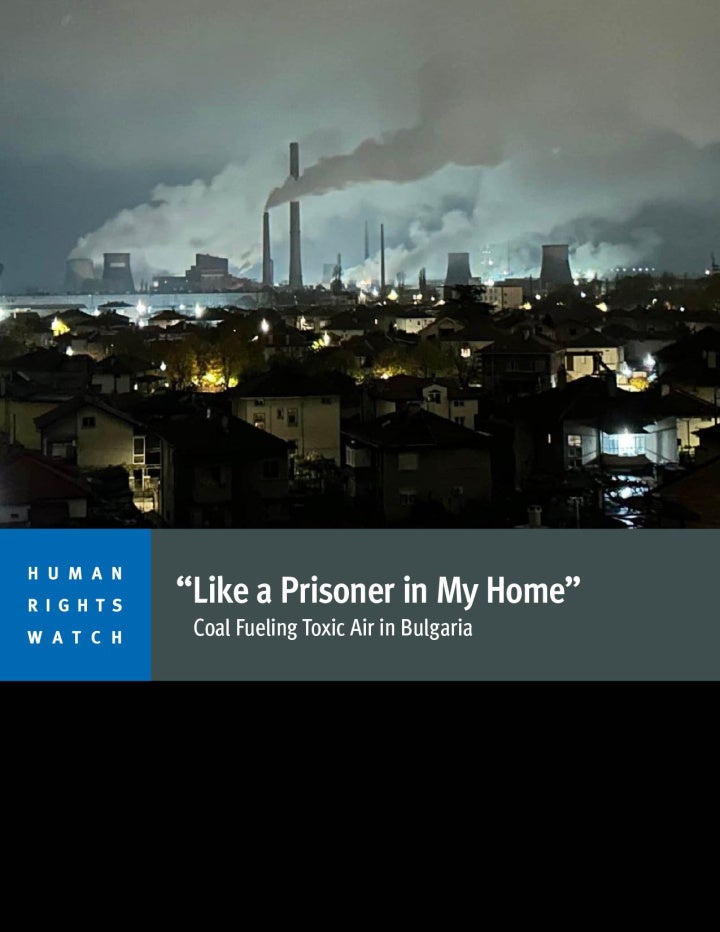
A photo taken on November 12, 2024, shows an episode of heavy pollution at the Maritsa 3 power plant in Dimitrovgrad, Bulgaria.
© 2024 Megchy Ioakimova
Bobi, a 7-year-old boy who lives in Dimitrovgrad, a town in southern Bulgaria, was diagnosed with chronic asthma when he was just six months old. His mother, Maria, never goes a day without worrying about him. Bobi has been exposed to toxic air pollution his whole life, profoundly harming his health. He is frequently hospitalized because of asthma attacks and often misses school. “I want the government to know that I no longer want to be sick and that I want clean air to breathe,” Bobi said.
Bobi is not alone. Across Dimitrovgrad, both residents and health professionals report serious and widespread health impacts from air pollution. According to health professionals interviewed by Human Rights Watch, residents of Dimitrovgrad experience high rates of respiratory illnesses like bronchitis, asthma, and lung cancer. Children in Dimitrovgrad appear to have higher rates of respiratory illnesses than those living in nearby cities, according to government health data. But chronic illness in childhood harms more than health. Some children in Dimitrovgrad regularly miss classes due to their illnesses.
Fortunately, there is some relief in sight. Like all EU-member states, Bulgaria is required by the revised Ambient Air Quality Directive (AAQD) to improve its current air quality standards by December 2026 and ensure full compliance with the new standards by 2030. While not as strict as WHO guidelines, the new 2030 standards will be more protective of public health and will go a long way toward fulfilling the right to health in Bulgaria.
But the obligation to improve its air quality puts Bulgaria on a collision course with the country’s ten coal-fired power plants. According to a 2024 study by the Center for Research on Energy and Clean Air, air pollution from Bulgaria’s coal plants leads to 333 excess deaths per year. Coupled with chronic and acute illnesses linked to coal plants, this study estimated that the health harms of burning coal cost Bulgaria €742 million annually.
Dimitrovgrad hosts one of the country’s oldest coal-fired power plants – Thermal Power Plant Maritsa 3 (“Maritsa 3”). Like Bulgaria’s nine other coal plants, Maritsa 3 emits hazardous air pollutants that contribute to poor air quality, according to Human Rights Watch’s analysis of publicly available official data. There are various other sources of air pollution in Dimitrovgrad – including from heating, transport, and industry. But Maritsa 3’s contribution to Dimitrovgrad’s high concentrations of sulfur dioxide (SO2), a pollutant harmful to human health, has been acknowledged by environmental authorities for years. In correspondence with Human Rights Watch, Bulgaria’s Ministry of Environment and the Regional Inspectorate of Environment and Water (RIEW) stated, “The source of sulfur dioxide emissions into the atmosphere in the territory of Dimitrovgrad is Maritsa 3.”
Dimitrovgrad’s high concentrations of SO2 prompted the administrative shutdown of Maritsa 3 in April 2022. For its part, the company that operates Maritsa 3 acknowledges that the plant contributes to SO2 levels, but stresses that the plant’s emissions have complied with current (2008) limits and not resulted in any administrative sanctions since 2022. They also emphasize other contributing factors, “including meteorological conditions, domestic heating, and pollution from power plants outside the city.”
In researching this report, Human Rights Watch analyzed the publically available official monitoring data to assess the impact of Maritsa 3’s operation on SO2 levels in Dimitrovgrad, controlling for several environmental conditions, as well as for the operation and output from the Maritsa Iztok complex of coal plants approximately 40 kilometers to the east.
We found that whether the Maritsa 3 plant in Dimitrovgrad is operating is the strongest predictor of SO2 levels in the city. Intermittent shutdowns of Maritsa 3—following periods when SO2 levels spike—as well as low overall electricity production contribute to Dimitrovgrad’s compliance with the current (2008) SO2 standards.
But air quality standards will soon become stricter. In both written responses to Human Rights Watch and in-person meetings with environmental authorities, the Bulgarian government has made clear that it intends to tighten air regulations on schedule. Our analysis of the publically available official data shows that even if Maritsa 3 continues to operate well below capacity and intermittently shuts down, as it has done since 2022, Dimitrovgrad will frequently exceed the daily and hourly SO2 levels once those standards are tightened.
Asked how it was preparing to meet the revised air quality standards, Maritsa 3 said it was “in the process of strategic plan
© 2024 Megchy Ioakimova
Bobi, a 7-year-old boy who lives in Dimitrovgrad, a town in southern Bulgaria, was diagnosed with chronic asthma when he was just six months old. His mother, Maria, never goes a day without worrying about him. Bobi has been exposed to toxic air pollution his whole life, profoundly harming his health. He is frequently hospitalized because of asthma attacks and often misses school. “I want the government to know that I no longer want to be sick and that I want clean air to breathe,” Bobi said.
Bobi is not alone. Across Dimitrovgrad, both residents and health professionals report serious and widespread health impacts from air pollution. According to health professionals interviewed by Human Rights Watch, residents of Dimitrovgrad experience high rates of respiratory illnesses like bronchitis, asthma, and lung cancer. Children in Dimitrovgrad appear to have higher rates of respiratory illnesses than those living in nearby cities, according to government health data. But chronic illness in childhood harms more than health. Some children in Dimitrovgrad regularly miss classes due to their illnesses.
Fortunately, there is some relief in sight. Like all EU-member states, Bulgaria is required by the revised Ambient Air Quality Directive (AAQD) to improve its current air quality standards by December 2026 and ensure full compliance with the new standards by 2030. While not as strict as WHO guidelines, the new 2030 standards will be more protective of public health and will go a long way toward fulfilling the right to health in Bulgaria.
But the obligation to improve its air quality puts Bulgaria on a collision course with the country’s ten coal-fired power plants. According to a 2024 study by the Center for Research on Energy and Clean Air, air pollution from Bulgaria’s coal plants leads to 333 excess deaths per year. Coupled with chronic and acute illnesses linked to coal plants, this study estimated that the health harms of burning coal cost Bulgaria €742 million annually.
Dimitrovgrad hosts one of the country’s oldest coal-fired power plants – Thermal Power Plant Maritsa 3 (“Maritsa 3”). Like Bulgaria’s nine other coal plants, Maritsa 3 emits hazardous air pollutants that contribute to poor air quality, according to Human Rights Watch’s analysis of publicly available official data. There are various other sources of air pollution in Dimitrovgrad – including from heating, transport, and industry. But Maritsa 3’s contribution to Dimitrovgrad’s high concentrations of sulfur dioxide (SO2), a pollutant harmful to human health, has been acknowledged by environmental authorities for years. In correspondence with Human Rights Watch, Bulgaria’s Ministry of Environment and the Regional Inspectorate of Environment and Water (RIEW) stated, “The source of sulfur dioxide emissions into the atmosphere in the territory of Dimitrovgrad is Maritsa 3.”
Dimitrovgrad’s high concentrations of SO2 prompted the administrative shutdown of Maritsa 3 in April 2022. For its part, the company that operates Maritsa 3 acknowledges that the plant contributes to SO2 levels, but stresses that the plant’s emissions have complied with current (2008) limits and not resulted in any administrative sanctions since 2022. They also emphasize other contributing factors, “including meteorological conditions, domestic heating, and pollution from power plants outside the city.”
In researching this report, Human Rights Watch analyzed the publically available official monitoring data to assess the impact of Maritsa 3’s operation on SO2 levels in Dimitrovgrad, controlling for several environmental conditions, as well as for the operation and output from the Maritsa Iztok complex of coal plants approximately 40 kilometers to the east.
We found that whether the Maritsa 3 plant in Dimitrovgrad is operating is the strongest predictor of SO2 levels in the city. Intermittent shutdowns of Maritsa 3—following periods when SO2 levels spike—as well as low overall electricity production contribute to Dimitrovgrad’s compliance with the current (2008) SO2 standards.
But air quality standards will soon become stricter. In both written responses to Human Rights Watch and in-person meetings with environmental authorities, the Bulgarian government has made clear that it intends to tighten air regulations on schedule. Our analysis of the publically available official data shows that even if Maritsa 3 continues to operate well below capacity and intermittently shuts down, as it has done since 2022, Dimitrovgrad will frequently exceed the daily and hourly SO2 levels once those standards are tightened.
Asked how it was preparing to meet the revised air quality standards, Maritsa 3 said it was “in the process of strategic plan