How the U Visa Builds Trust, Counters Fear, and Promotes Community Safety
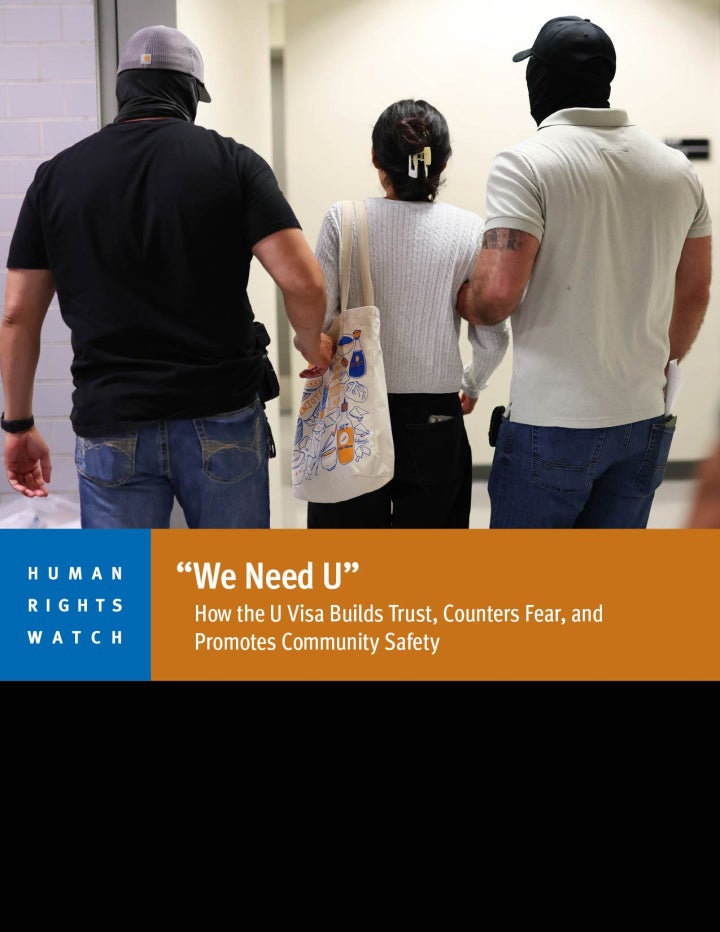
Federal agents detain a woman exiting an immigration court hearing in New York City, on August 1, 2025.
© 2025 Michael M. Santiago/Getty Images
In 2018, during the first Trump administration’s immigration crackdown, Human Rights Watch issued a report outlining the public safety benefits of visa programs for undocumented victims of crime.[1] The report was prepared in response to concerns expressed by advocacy groups that the visas might be vulnerable because many policymakers did not fully appreciate how important they are for the victims of crimes or how they benefit law enforcement. Seven years later, the situation for undocumented victims of crime is more precarious than ever.
Promises of mass deportation and fighting crime were pillars of US President Donald Trump’s election campaigns. “I have a message for all of you,” he said in his first campaign. “The crime and violence that today afflicts America will soon-and I mean very soon-come to an end.”[2] President Trump has repeatedly singled out people without lawful immigration status as responsible for crime, contrary to significant evidence, and interpreted his 2024 reelection as a broad mandate to forcibly remove thousands of undocumented people under the pretext of getting rid of “the worst of the worst” and “killers.”
Making communities safer through the criminal justice system requires people to cooperate with law enforcement by reporting crimes and to assist with investigations and prosecutions. Despite the purported commitment to “making America safe again,” recent immigration enforcement tactics and policies, as well as cuts in support for undocumented victims of crimes—such as the Department of Justice withholding funding for rape kits for undocumented people if states do not cooperate with immigration enforcement efforts—make it less likely that immigrant victims will feel safe reporting crimes.[3]
Twenty-five years ago, Congress enacted the Victims of Trafficking and Violence Protection Act of 2000 (TVPA) with overwhelming bipartisan support. This landmark legislation established two critical instruments for law enforcement: the T visa, designed to assist victims of human trafficking, and the U visa, designed to assist noncitizen victims of qualifying crimes such as domestic violence, sexual assault, and felonious assault. In passing this legislation, Congress recognized that perpetrators of violent crime frequently target undocumented individuals because of their inherent vulnerability and fear of deportation. By creating a mechanism to insulate victims from removal in exchange for cooperation, lawmakers sought to disarm criminals of their most potent weapon, coercion, and thereby strengthen law enforcement’s ability to detect and investigate crime
Under the U visa program, survivors of rape, domestic violence, trafficking and 25 other qualifying crimes have a pathway to legal status if they cooperate with law enforcement or another certifying agency, have suffered substantial physical or mental abuse, and are otherwise admissible to the US or qualify for a waiver. Under the T visa program, survivors of human trafficking have a path to legal status if they can demonstrate that they are in the United States on account of the trafficking, comply with reasonable requests for assistance in the detention, investigation, or prosecution of human trafficking (unless an exemption or exception applies), show they would suffer extreme hardship if removed from the United States, and are otherwise admissible to the United States or qualify for a waiver. Three years after receiving a U or T visa, survivors are eligible for permanent residency status.
The program helps people like Elana C. In June 2023, after years of abuse, Elana’s boyfriend nearly killed her. He punched her, cut her hand and face with a knife, hit her with a bottle and choked her to the point of unconsciousness while threatening to kill her, saying she would be in a “body bag” and he would be deported back to the Dominican Republic. She had to be transported to the hospital emergency room to be treated for severe lacerations and a fractured shoulder. While in the hospital she worked up the courage to report to the New York Police Department, a decision that likely saved her life. The police are still looking for her abuser, and she is afraid but also believes she would be dead if she had not reported. Her U visa petition is pending.
While U visas were initially intended to help victims like Elana and are primarily granted in cases of domestic or sexual violence or felonious assault, the benefits stretch far beyond intimate partner violence cases and immigrant communities. EderCastillo, a prosecutor in Hennepin County, Minnesota said, “The idea that the perpetrator will only harm one community can’t be right. They will do harm to
Federal agents detain a woman exiting an immigration court hearing in New York City, on August 1, 2025.
© 2025 Michael M. Santiago/Getty Images
In 2018, during the first Trump administration’s immigration crackdown, Human Rights Watch issued a report outlining the public safety benefits of visa programs for undocumented victims of crime.[1] The report was prepared in response to concerns expressed by advocacy groups that the visas might be vulnerable because many policymakers did not fully appreciate how important they are for the victims of crimes or how they benefit law enforcement. Seven years later, the situation for undocumented victims of crime is more precarious than ever.
Promises of mass deportation and fighting crime were pillars of US President Donald Trump’s election campaigns. “I have a message for all of you,” he said in his first campaign. “The crime and violence that today afflicts America will soon-and I mean very soon-come to an end.”[2] President Trump has repeatedly singled out people without lawful immigration status as responsible for crime, contrary to significant evidence, and interpreted his 2024 reelection as a broad mandate to forcibly remove thousands of undocumented people under the pretext of getting rid of “the worst of the worst” and “killers.”
Making communities safer through the criminal justice system requires people to cooperate with law enforcement by reporting crimes and to assist with investigations and prosecutions. Despite the purported commitment to “making America safe again,” recent immigration enforcement tactics and policies, as well as cuts in support for undocumented victims of crimes—such as the Department of Justice withholding funding for rape kits for undocumented people if states do not cooperate with immigration enforcement efforts—make it less likely that immigrant victims will feel safe reporting crimes.[3]
Twenty-five years ago, Congress enacted the Victims of Trafficking and Violence Protection Act of 2000 (TVPA) with overwhelming bipartisan support. This landmark legislation established two critical instruments for law enforcement: the T visa, designed to assist victims of human trafficking, and the U visa, designed to assist noncitizen victims of qualifying crimes such as domestic violence, sexual assault, and felonious assault. In passing this legislation, Congress recognized that perpetrators of violent crime frequently target undocumented individuals because of their inherent vulnerability and fear of deportation. By creating a mechanism to insulate victims from removal in exchange for cooperation, lawmakers sought to disarm criminals of their most potent weapon, coercion, and thereby strengthen law enforcement’s ability to detect and investigate crime
Under the U visa program, survivors of rape, domestic violence, trafficking and 25 other qualifying crimes have a pathway to legal status if they cooperate with law enforcement or another certifying agency, have suffered substantial physical or mental abuse, and are otherwise admissible to the US or qualify for a waiver. Under the T visa program, survivors of human trafficking have a path to legal status if they can demonstrate that they are in the United States on account of the trafficking, comply with reasonable requests for assistance in the detention, investigation, or prosecution of human trafficking (unless an exemption or exception applies), show they would suffer extreme hardship if removed from the United States, and are otherwise admissible to the United States or qualify for a waiver. Three years after receiving a U or T visa, survivors are eligible for permanent residency status.
The program helps people like Elana C. In June 2023, after years of abuse, Elana’s boyfriend nearly killed her. He punched her, cut her hand and face with a knife, hit her with a bottle and choked her to the point of unconsciousness while threatening to kill her, saying she would be in a “body bag” and he would be deported back to the Dominican Republic. She had to be transported to the hospital emergency room to be treated for severe lacerations and a fractured shoulder. While in the hospital she worked up the courage to report to the New York Police Department, a decision that likely saved her life. The police are still looking for her abuser, and she is afraid but also believes she would be dead if she had not reported. Her U visa petition is pending.
While U visas were initially intended to help victims like Elana and are primarily granted in cases of domestic or sexual violence or felonious assault, the benefits stretch far beyond intimate partner violence cases and immigrant communities. EderCastillo, a prosecutor in Hennepin County, Minnesota said, “The idea that the perpetrator will only harm one community can’t be right. They will do harm to