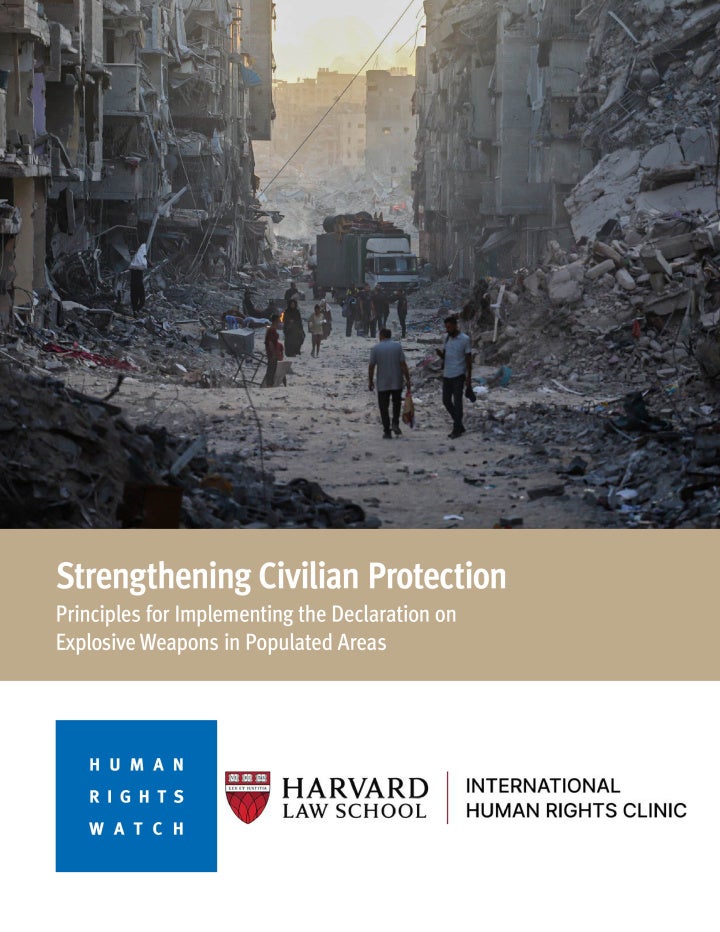
Principles for Implementing the Declaration on Explosive Weapons in Populated Areas
Countries should endorse and implement a new political declaration protecting civilians from the use of explosive weapons in populated areas.
Palestinians walk through the rubble of residential buildings destroyed by Israeli forces in Sheikh Radwan neighborhood in northern Gaza City, October 13, 2025.
© 2025 Sipa via AP Images
Countries should endorse and implement a new political declaration protecting civilians from the use of explosive weapons in populated areas.
The bombing and shelling of cities, towns, and villages has long wreaked havoc on civilians in armed conflicts around the world. Such attacks in recent years have reduced the densely populated Gaza Strip and urban centers of Ukraine to rubble. In 2024-2025 alone, civilians in Cambodia, the Democratic Republic of Congo, Lebanon, Myanmar, Sudan, Syria, and Thailand have also experienced the grave effects of this method of warfare, which is known as the use of explosive weapons in populated areas.[1] The nongovernmental organization Action on Armed Violence recorded more than 57,000 civilian casualties from the use of explosive weapons in populated areas in 2024.[2] The attacks frequently left survivors without homes, functioning civilian infrastructure, and basic services, such as education and health care; damaged cultural heritage and the environment; and displaced whole communities.[3]
Human Rights Watch documentation over the past few years underscores the nature and breadth of the effects of the use of explosive weapons.[4] For example, a single Israeli airstrike on a six-story apartment building in Gaza killed at least 106 civilians, including 54 children, on October 31, 2023.[5] Between February and May 2024, Rwandan armed forces and the M23 armed group used ground-launched rockets against displacement camps in eastern Democratic Republic of Congo; three rockets launched within an hour killed and injured at least 52 civilians on May 3, 2025.[6] Infrastructure has frequently suffered damage in these types of attacks. In Lebanon, an Israeli strike on a water filtration and pumping station in Tyre on November 18, 2024, disrupted access to services for about 72,000 people in the city and surrounding areas, according to public utility technicians. While temporary access to water returned after a month, the facility itself needed be rebuilt.[7] Since Russia’s full-scale invasion of Ukraine in February 2022, Russian airstrikes, missiles, and artillery have caused significant damage to Ukrainian cultural heritage as well as leveled urban areas and caused tens of thousands of civilian casualties. The total destruction of the landmark Donetsk Academic Regional Drama Theater in Mariupol and the home of Ukrainian national poet Hryhorii Skovoroda in the Kharkivska region exemplifies such loss.[8]
All of these attacks have led to mass displacement. After border clashes between Thailand and Cambodia involving heavy artillery, rockets, and other explosive weapons in July 2025, Thai authorities reported that they evacuated 100,000 people from the area and closed at least 852 schools and 7 hospitals for safety reasons.[9]
Given these devastating human costs, states should mobilize political will and dedicate time and resources to minimizing the effects of explosive weapons through implementation of recently endorsed international commitments. The 2022 Political Declaration on Strengthening the Protection of Civilians from the Humanitarian Consequences Arising from the Use of Explosive Weapons in Populated Areas (the Declaration) had been endorsed by 88 states as of November 2025 (see Appendix).[10] Universalization of the instrument remains important, but governments should also focus on operationalizing its provisions. International commitments are only as good as their national implementation, which both influences the conduct of the implementing state and sets standards that can inform the conduct of others.
The Declaration, while non-binding, provides a comprehensive framework for preventing and remediating the civilian harm caused by the bombing and shelling of urban areas. Its preamble details the devastating direct and indirect consequences caused by this method of warfare. Its commitments call on endorsing states to reduce civilian casualties and other impacts caused by explosive weapons through changes to policies and practices and to address harm that has already occurred through victim assistance and facilitation of humanitarian aid delivery. The Declaration also stresses the importance of data collection and repeatedly references the value of partnering with other stakeholders.
This report is being released in conjunction with the Second International Conference of the Declaration in San José, Costa Rica, in November 2025. It builds on a 2022 publication by Human Rights Watch and Harvard Law School’
Countries should endorse and implement a new political declaration protecting civilians from the use of explosive weapons in populated areas.
Palestinians walk through the rubble of residential buildings destroyed by Israeli forces in Sheikh Radwan neighborhood in northern Gaza City, October 13, 2025.
© 2025 Sipa via AP Images
Countries should endorse and implement a new political declaration protecting civilians from the use of explosive weapons in populated areas.
The bombing and shelling of cities, towns, and villages has long wreaked havoc on civilians in armed conflicts around the world. Such attacks in recent years have reduced the densely populated Gaza Strip and urban centers of Ukraine to rubble. In 2024-2025 alone, civilians in Cambodia, the Democratic Republic of Congo, Lebanon, Myanmar, Sudan, Syria, and Thailand have also experienced the grave effects of this method of warfare, which is known as the use of explosive weapons in populated areas.[1] The nongovernmental organization Action on Armed Violence recorded more than 57,000 civilian casualties from the use of explosive weapons in populated areas in 2024.[2] The attacks frequently left survivors without homes, functioning civilian infrastructure, and basic services, such as education and health care; damaged cultural heritage and the environment; and displaced whole communities.[3]
Human Rights Watch documentation over the past few years underscores the nature and breadth of the effects of the use of explosive weapons.[4] For example, a single Israeli airstrike on a six-story apartment building in Gaza killed at least 106 civilians, including 54 children, on October 31, 2023.[5] Between February and May 2024, Rwandan armed forces and the M23 armed group used ground-launched rockets against displacement camps in eastern Democratic Republic of Congo; three rockets launched within an hour killed and injured at least 52 civilians on May 3, 2025.[6] Infrastructure has frequently suffered damage in these types of attacks. In Lebanon, an Israeli strike on a water filtration and pumping station in Tyre on November 18, 2024, disrupted access to services for about 72,000 people in the city and surrounding areas, according to public utility technicians. While temporary access to water returned after a month, the facility itself needed be rebuilt.[7] Since Russia’s full-scale invasion of Ukraine in February 2022, Russian airstrikes, missiles, and artillery have caused significant damage to Ukrainian cultural heritage as well as leveled urban areas and caused tens of thousands of civilian casualties. The total destruction of the landmark Donetsk Academic Regional Drama Theater in Mariupol and the home of Ukrainian national poet Hryhorii Skovoroda in the Kharkivska region exemplifies such loss.[8]
All of these attacks have led to mass displacement. After border clashes between Thailand and Cambodia involving heavy artillery, rockets, and other explosive weapons in July 2025, Thai authorities reported that they evacuated 100,000 people from the area and closed at least 852 schools and 7 hospitals for safety reasons.[9]
Given these devastating human costs, states should mobilize political will and dedicate time and resources to minimizing the effects of explosive weapons through implementation of recently endorsed international commitments. The 2022 Political Declaration on Strengthening the Protection of Civilians from the Humanitarian Consequences Arising from the Use of Explosive Weapons in Populated Areas (the Declaration) had been endorsed by 88 states as of November 2025 (see Appendix).[10] Universalization of the instrument remains important, but governments should also focus on operationalizing its provisions. International commitments are only as good as their national implementation, which both influences the conduct of the implementing state and sets standards that can inform the conduct of others.
The Declaration, while non-binding, provides a comprehensive framework for preventing and remediating the civilian harm caused by the bombing and shelling of urban areas. Its preamble details the devastating direct and indirect consequences caused by this method of warfare. Its commitments call on endorsing states to reduce civilian casualties and other impacts caused by explosive weapons through changes to policies and practices and to address harm that has already occurred through victim assistance and facilitation of humanitarian aid delivery. The Declaration also stresses the importance of data collection and repeatedly references the value of partnering with other stakeholders.
This report is being released in conjunction with the Second International Conference of the Declaration in San José, Costa Rica, in November 2025. It builds on a 2022 publication by Human Rights Watch and Harvard Law School’