Malnutrition is a public health emergency in Nigeria, with around 3.5 million children under five projected to suffer from life threatening severe acute malnutrition (SAM) in the country this year, according to the Nigerian government and the UN.
This situation massively affects northern states of Nigeria, among which Kebbi State. Since June, more than 400 severely malnourished children are hospitalised each week in the ITFCs we run in Kebbi, while over 1,400 are admitted to outpatient care weekly. More than 9,000 children are now enrolled in our outpatient nutrition programme. These numbers are staggering—and they’re still rising. The situation is so dire that we even had to stop treating children with moderate acute malnutrition because so many others are in more critical condition.
Across Northern Nigeria, a devastating nutrition crisis is unfolding. Katrin Kisswani, a nurse and President of MSF Belgium, has just returned from Kebbi, a state in the northwest of the country. Here, she shares what the team is witnessing on the ground—day after day.
Help us provide vital medical care to those who need it most.
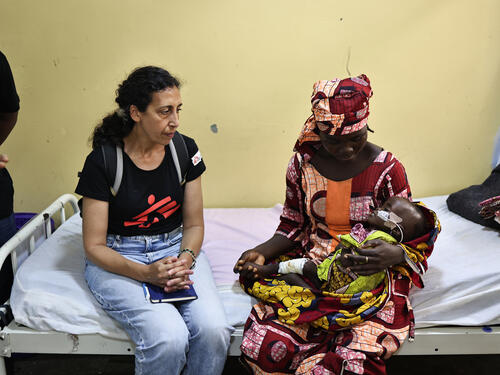
“She was barely conscious when we arrived,” says Rukayya, cradling her little daughter in her lap. Hamida is nearly two, she tells me. When they arrived at Sir Yahaya Hospital in Kebbi a week ago, they were rushed straight into the emergency department. After a rapid assessment, Hamida was admitted to MSF’s inpatient therapeutic feeding centre. Her diagnosis was the same as every child admitted here: severe acute malnutrition.
Over the past twenty years, I’ve worked in MSF facilities around the world, but this is the first time I’ve seen an MSF project with such a massive number of malnourished patients. Our team in Kebbi runs two inpatient facilities and six outpatient clinics. Since June, more than 400 severely malnourished children have been hospitalised per week, while over 1,400 have received outpatient care weekly. The project uses 100,000 sachets of therapeutic food every week. Today, more than 9,000 children are enrolled in our outpatient nutrition programme. These numbers are staggering—and they’re still rising.
The causes of this crisis are complex. The economic situation in Kebbi is precarious, and food prices have skyrocketed. The security situation in several areas remains volatile, disrupting farming and limiting access to markets. Most people in Kebbi State don’t have access to clean water, and basic healthcare—including childhood vaccinations—is often unavailable or unaffordable. Sick children are far more vulnerable to malnutrition, and here they fall sick repeatedly with malaria, measles, diarrhoea, and tuberculosis—with little access to treatment.
This is not unique to Kebbi. The same situation is playing out across much of Northern Nigeria, in a crisis that has been building for years—and is now at an enormous scale.
In the emergency room and intensive care unit at the hospital, one thing struck me: the children were almost silent. Even during painful procedures like inserting an intravenous line—they didn’t have the energy to cry.
As I spoke with some of the mothers—through a translator—the same story kept coming up. Their child had fallen ill. They had tried to get care, but it was either unavailable or ineffective.
One woman told me her two-year-old son, Yakuba, had been sick with watery diarrhoea and fever. Desperate, and unable to get help locally, she travelled over 80 kilometers to reach the MSF facility. Another mother told me her one-year-old daughter, Kakamele, was born with a cleft lip and palate, making it difficult to eat. When she sought help at another hospital, she was told her daughter was too malnourished for surgery. By the time she reached our hospital, Kakamele was in such critical condition that she had to be admitted straight to the intensive care unit.
Typically, malnutrition cases are seasonal—the numbers fall after the harvest. But in Kebbi, that’s not happening. The numbers continue to rise, and the team is having to constantly adapt. Our colleagues have built an additional inpatient facility—but it’s already over capacity. They’ve even had to stop treating children with moderate acute malnutrition because so many others are in more critical condition.
When it was time for me to leave Kebbi, I felt mixed emotions. I was immensely proud of what we had achieved. MSF’s work in Kebbi is life-saving. But we cannot solve this crisis alone.
The nutrition crisis in Northern Nigeria is a public health emergency. Children are dying, the crisis is out of control, and the outlook is worsening given the cuts to international aid budgets.
Prevention must be prioritised by the Nigerian authorities and aid organisations, with funding made available for food or cash distributions, vaccination programmes, and community health centres. Supply chain issues for therapeutic food must also be urgentl
This situation massively affects northern states of Nigeria, among which Kebbi State. Since June, more than 400 severely malnourished children are hospitalised each week in the ITFCs we run in Kebbi, while over 1,400 are admitted to outpatient care weekly. More than 9,000 children are now enrolled in our outpatient nutrition programme. These numbers are staggering—and they’re still rising. The situation is so dire that we even had to stop treating children with moderate acute malnutrition because so many others are in more critical condition.
Across Northern Nigeria, a devastating nutrition crisis is unfolding. Katrin Kisswani, a nurse and President of MSF Belgium, has just returned from Kebbi, a state in the northwest of the country. Here, she shares what the team is witnessing on the ground—day after day.
Help us provide vital medical care to those who need it most.
“She was barely conscious when we arrived,” says Rukayya, cradling her little daughter in her lap. Hamida is nearly two, she tells me. When they arrived at Sir Yahaya Hospital in Kebbi a week ago, they were rushed straight into the emergency department. After a rapid assessment, Hamida was admitted to MSF’s inpatient therapeutic feeding centre. Her diagnosis was the same as every child admitted here: severe acute malnutrition.
Over the past twenty years, I’ve worked in MSF facilities around the world, but this is the first time I’ve seen an MSF project with such a massive number of malnourished patients. Our team in Kebbi runs two inpatient facilities and six outpatient clinics. Since June, more than 400 severely malnourished children have been hospitalised per week, while over 1,400 have received outpatient care weekly. The project uses 100,000 sachets of therapeutic food every week. Today, more than 9,000 children are enrolled in our outpatient nutrition programme. These numbers are staggering—and they’re still rising.
The causes of this crisis are complex. The economic situation in Kebbi is precarious, and food prices have skyrocketed. The security situation in several areas remains volatile, disrupting farming and limiting access to markets. Most people in Kebbi State don’t have access to clean water, and basic healthcare—including childhood vaccinations—is often unavailable or unaffordable. Sick children are far more vulnerable to malnutrition, and here they fall sick repeatedly with malaria, measles, diarrhoea, and tuberculosis—with little access to treatment.
This is not unique to Kebbi. The same situation is playing out across much of Northern Nigeria, in a crisis that has been building for years—and is now at an enormous scale.
In the emergency room and intensive care unit at the hospital, one thing struck me: the children were almost silent. Even during painful procedures like inserting an intravenous line—they didn’t have the energy to cry.
As I spoke with some of the mothers—through a translator—the same story kept coming up. Their child had fallen ill. They had tried to get care, but it was either unavailable or ineffective.
One woman told me her two-year-old son, Yakuba, had been sick with watery diarrhoea and fever. Desperate, and unable to get help locally, she travelled over 80 kilometers to reach the MSF facility. Another mother told me her one-year-old daughter, Kakamele, was born with a cleft lip and palate, making it difficult to eat. When she sought help at another hospital, she was told her daughter was too malnourished for surgery. By the time she reached our hospital, Kakamele was in such critical condition that she had to be admitted straight to the intensive care unit.
Typically, malnutrition cases are seasonal—the numbers fall after the harvest. But in Kebbi, that’s not happening. The numbers continue to rise, and the team is having to constantly adapt. Our colleagues have built an additional inpatient facility—but it’s already over capacity. They’ve even had to stop treating children with moderate acute malnutrition because so many others are in more critical condition.
When it was time for me to leave Kebbi, I felt mixed emotions. I was immensely proud of what we had achieved. MSF’s work in Kebbi is life-saving. But we cannot solve this crisis alone.
The nutrition crisis in Northern Nigeria is a public health emergency. Children are dying, the crisis is out of control, and the outlook is worsening given the cuts to international aid budgets.
Prevention must be prioritised by the Nigerian authorities and aid organisations, with funding made available for food or cash distributions, vaccination programmes, and community health centres. Supply chain issues for therapeutic food must also be urgentl