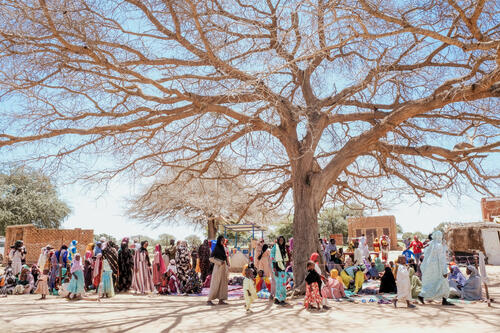
This year, MSF teams have been working in unimaginably challenging conditions to deliver crucial medical care. Thanks to your support, we've been able to move fast in response to rapidly-evolving crises and be there for people who continue to suffer long after the headlines stop.
Dr Natalie Roberts is the Executive Director of Médecins Sans Frontières / Doctors Without Borders (MSF) in the UK.
A British emergency doctor, Natalie joined MSF in 2012 and has worked in crises across Africa, Asia and the Middle East, including in Syria, Yemen, Ukraine, Pakistan, the Philippines, Ethiopia and the Central African Republic.
In 2016, she became Head of Emergency Operations for MSF in Paris, overseeing MSF’s emergency response programmes worldwide. Before she took up her current role, she was Director of Studies for Crash, an MSF think tank in Paris.
Looking back at 2025, I see both monumental challenges and reasons for hope.
The devastation of the genocide in Gaza has pushed the humanitarian system, and the law that upholds it, to the limit. What our teams have witnessed in shelled hospitals and health facilities across the Strip has been beyond what any of our staff have experienced before. More than indiscriminate, the inhumanity has been orchestrated, with aid itself becoming a weapon of war.
As I write, more than 70,000 Palestinians have been killed since the horrifying events in Israel on 7 October 2023, including many since the latest ceasefire was declared. Fifteen of our own colleagues are counted among the dead. And yet, I continue to be awestruck by the dedication of our staff, working under extreme pressure, at times facing starvation, always striving to preserve life in Gaza.
Words equally fail to capture the scale of the crisis in Sudan. Atrocities continue unabated, particularly in the cities of Darfur, where men, women and children have been besieged, starved, and massacred. More than 30 million people are now in need of basic assistance, including 12 million who have been forced from their homes. In Darfur, and across Sudan, our teams work tirelessly to provide medical care to the sick and injured, as violence and disease spread with equal ferocity.
Early in the year, the US Government announced plans to dismantle USAID – the world’s largest supplier of aid – followed in February by the UK cutting its own aid budget to the lowest level seen in decades. At a time of multiple acute crises and huge geopolitical instability, these short-sighted decisions are already directly affecting healthcare programmes worldwide. They are predicted to cost a staggering 14 million lives by 2030.
MSF does not rely on such government funding. Instead, we can operate with true independence. But the need for our work will now become greater than ever as preventable crises escalate in a world that is seemingly turning its back on international solidarity.
That vital independence does not come from nowhere – it comes from you. It is only with your backing that we can save lives. Every pound raised, ticket sold and mile run in support of MSF... it makes the most incredible difference for our staff and patients.
From Gaza to Sudan, the Democratic Republic of Congo to Ukraine, there are people you may never meet, in a place you may never visit, who are only alive and healthy because of what you have given.
From all of us at MSF UK, and on behalf of our colleagues around the world, I want to say a very sincere thank you. I wish you a safe, warm and welcoming festive break.
Few humanitarian events have been experienced like Israel’s war on Gaza. The astonishing situation faced by civilians has been broadcast around the world and filled social media feeds for more than two years in an unrelenting stream of suffering.
For those inside the Strip, the violence evolved in 2025 with the clear weaponisation of aid. We witnessed the establishment of the Gaza Humanitarian Fund - an Israeli-US-backed proxy - that has seen more than 900 civilians shot during its food distributions. Meanwhile, mass starvation has gripped the entire population, causing death and driving disease. With supplies low and aid blockaded, MSF teams were not immune - many lived and worked with extreme hunger.
MSF teams in Gaza have now carried out over 1.4 million consultations, performed more than 20,000 surgeries and assisted in almost another 20,000 births. And, despite the ceasefire that came into effect on 10 October, we have continued to see civilians killed and injured, and no let-up in the vast medical needs of Palestinians.
This year, MSF declared the events in Gaza to be a genocide, citing Israel’s campaign of ethnic cleansing. MSF called on world leaders to act, while in the UK, we also launched a national campaign to draw attention to the UK Government’s complicity in the genocide. And, in recent weeks, we pushed the UK to facilitate further medical evacuations of some of the 18,500 people waiting for urgent care i
Dr Natalie Roberts is the Executive Director of Médecins Sans Frontières / Doctors Without Borders (MSF) in the UK.
A British emergency doctor, Natalie joined MSF in 2012 and has worked in crises across Africa, Asia and the Middle East, including in Syria, Yemen, Ukraine, Pakistan, the Philippines, Ethiopia and the Central African Republic.
In 2016, she became Head of Emergency Operations for MSF in Paris, overseeing MSF’s emergency response programmes worldwide. Before she took up her current role, she was Director of Studies for Crash, an MSF think tank in Paris.
Looking back at 2025, I see both monumental challenges and reasons for hope.
The devastation of the genocide in Gaza has pushed the humanitarian system, and the law that upholds it, to the limit. What our teams have witnessed in shelled hospitals and health facilities across the Strip has been beyond what any of our staff have experienced before. More than indiscriminate, the inhumanity has been orchestrated, with aid itself becoming a weapon of war.
As I write, more than 70,000 Palestinians have been killed since the horrifying events in Israel on 7 October 2023, including many since the latest ceasefire was declared. Fifteen of our own colleagues are counted among the dead. And yet, I continue to be awestruck by the dedication of our staff, working under extreme pressure, at times facing starvation, always striving to preserve life in Gaza.
Words equally fail to capture the scale of the crisis in Sudan. Atrocities continue unabated, particularly in the cities of Darfur, where men, women and children have been besieged, starved, and massacred. More than 30 million people are now in need of basic assistance, including 12 million who have been forced from their homes. In Darfur, and across Sudan, our teams work tirelessly to provide medical care to the sick and injured, as violence and disease spread with equal ferocity.
Early in the year, the US Government announced plans to dismantle USAID – the world’s largest supplier of aid – followed in February by the UK cutting its own aid budget to the lowest level seen in decades. At a time of multiple acute crises and huge geopolitical instability, these short-sighted decisions are already directly affecting healthcare programmes worldwide. They are predicted to cost a staggering 14 million lives by 2030.
MSF does not rely on such government funding. Instead, we can operate with true independence. But the need for our work will now become greater than ever as preventable crises escalate in a world that is seemingly turning its back on international solidarity.
That vital independence does not come from nowhere – it comes from you. It is only with your backing that we can save lives. Every pound raised, ticket sold and mile run in support of MSF... it makes the most incredible difference for our staff and patients.
From Gaza to Sudan, the Democratic Republic of Congo to Ukraine, there are people you may never meet, in a place you may never visit, who are only alive and healthy because of what you have given.
From all of us at MSF UK, and on behalf of our colleagues around the world, I want to say a very sincere thank you. I wish you a safe, warm and welcoming festive break.
Few humanitarian events have been experienced like Israel’s war on Gaza. The astonishing situation faced by civilians has been broadcast around the world and filled social media feeds for more than two years in an unrelenting stream of suffering.
For those inside the Strip, the violence evolved in 2025 with the clear weaponisation of aid. We witnessed the establishment of the Gaza Humanitarian Fund - an Israeli-US-backed proxy - that has seen more than 900 civilians shot during its food distributions. Meanwhile, mass starvation has gripped the entire population, causing death and driving disease. With supplies low and aid blockaded, MSF teams were not immune - many lived and worked with extreme hunger.
MSF teams in Gaza have now carried out over 1.4 million consultations, performed more than 20,000 surgeries and assisted in almost another 20,000 births. And, despite the ceasefire that came into effect on 10 October, we have continued to see civilians killed and injured, and no let-up in the vast medical needs of Palestinians.
This year, MSF declared the events in Gaza to be a genocide, citing Israel’s campaign of ethnic cleansing. MSF called on world leaders to act, while in the UK, we also launched a national campaign to draw attention to the UK Government’s complicity in the genocide. And, in recent weeks, we pushed the UK to facilitate further medical evacuations of some of the 18,500 people waiting for urgent care i